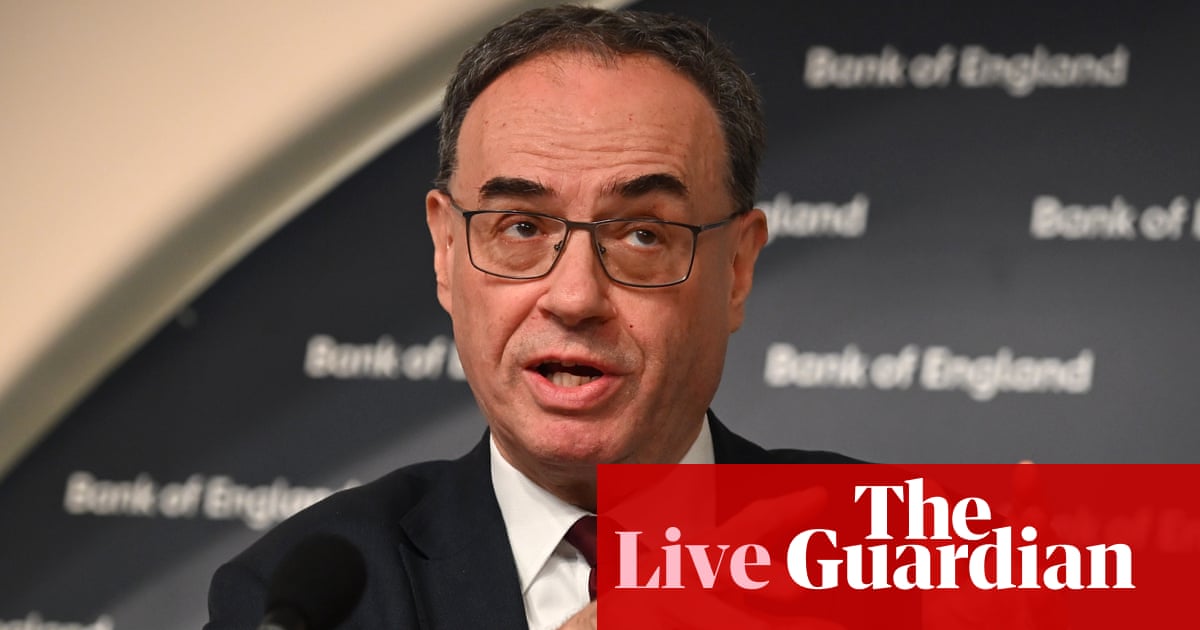
Bailey has also warned around the growing power of artificial intelligence models.
He told that lawmakers, not regulators, will need to set the guardrails for the technology.
He said:
It's a bit like rearing children. You have to give them the chance to do things, but you also have to set some sort of boundaries as it were.
…The public needs to trust this technology. There needs to be greater transparency, explanation of what the things do, how they do it, what we're doing.
It's sensible to come at it from that angle and say, we've got to have stronger government understanding, stronger government coordination on this stuff. Regulation may follow it."
Yesterday Bailey told a press conference that policymakers were worried about "open weight" AI – open source models, many of which are being developed in China.
The Bank also raised fears for the first time about emerging quantum computing capabilities potentially undermining the encryption technology that protects essential financial transactions.
Bailey emphasised that it was crucial, and possible, for banks to start to build up their defences against quantum risks, even while the technology was in nascent development. He said:
It could have powers that go beyond what we're seeing with frontier AI and have substantial power to undermine cryptography.
Yesterday the Bank's deputy governor for financial stability, , said it was important to keep in mind that households would "face this [mortgage] shock with strong balance sheets".
She said household debt was relatively low, at a level last seen in the early 2000s.
So they start from a position of some resilience. And secondly … while there's a distributional effect and some households would be hit more than others, in aggregate we think this is absorbable."
Good morning, and welcome to our rolling coverage of business, the financial markets and the world economy.
Some rather gloomy news to start Friday as , the governor of the Bank of , has warned that British banks will probably try to pass on the cost of higher taxes to their customers.
Last month the chancellor, announced plans to double the bank surcharge, which is levied on top of corporation tax, to 6% from January. He said the increase – expected to be worth £1.5bn – would be "time-limited", lasting 15 months, in order "to pay for immediate support on energy bills".
But has told that he would not be surprised if banks attempted to pass on higher levies so they could "protect their earnings".
He said:
It's a market economy, so these are decisions banks will have to take. You could understand that they will look to pass it on because they will be targeting a rate of return.
Now, how successful they will be depends on all sorts of things: market conditions, competition within the industry and so on. It wouldn't be surprising to find out that they will start by trying to do that.
Several analysts have predicted that banks will try to offset their higher tax bills by charging higher interest rates on loans or offering less generous saving rates.
Bailey's comments came as the Bank's latest report found that more than 400,000 UK homeowners will face a £500-a-month increase in their mortgage payments over the next three years, as rising interest rates heap extra pressure on households.
It found that out of the 7 million borrowers coming off fixed-rate deals before December 2029, about 6.5 million would have to cough up extra funds to cover their home loan payments.
Warnings about the increases came after policymakers at the Bank of England hiked interest rates from 3.75% to 4% this month. The Bank also hinted at another increase in interest rates to combat inflationary pressure caused by the Iran war. The financial markets have predicted three quarter-point rate rises by summer 2027.
Meanwhile energy bills are also rising – this week the energy regulator for Great Britain raised the cap on household energy bills by 26%, starting from January.