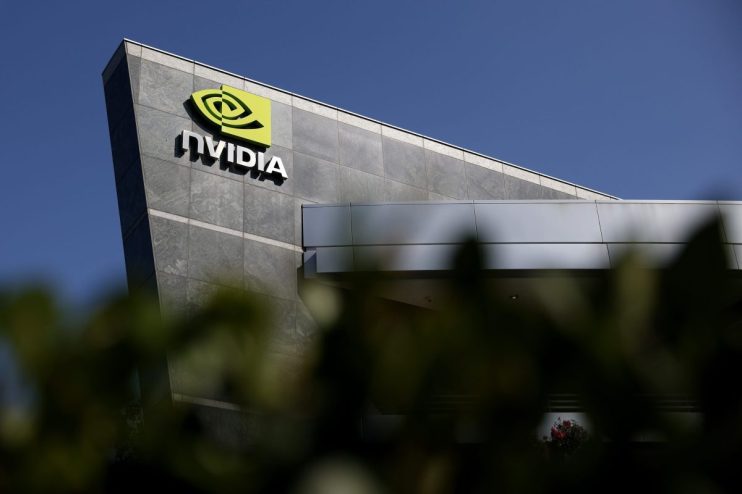
London-listed tech trusts suffered another fall on Tuesday morning as investors await Nvidia’s first results since the dramatic departure of Jensen Huang.
Nvidia’s share price sank 4.1 per cent in pre-market trading to $156.1 (£118.3), having plunged as much as 13 per cent last week, following Huang’s resignation as chief executive after 33 years at the helm.
Huang left his post following reports of multiple extramarital affairs, including one with a woman who is suspected of being a Chinese spy by US officials.
The stock has fallen 32 per cent from its October peak, leading to bruising sell-offs for a number of London-listed technology investment trusts who have bet big on the chipmaker at the heart of the AI trade.
The Nasdaq Composite Index also declined 2.4 per cent prior to the opening bell, while the S&P 500 slipped 1.9 per cent.
Stay in the know
Three daily briefings with the key market moves and top business and political stories.
SUBSCRIBE HEREInto the red
Trusts tumbled deeper into the red in early trading, as some investors opted to cash out before Nvidia’s latest earnings report is released after the closing bell on Wall Street.
Polar Capital Technology Trust, which has nearly 40 per cent of its portfolio exposed to semiconductor stocks, fell 2.1 per cent to 547.9p. Nvidia is Polar’s largest holding at 10 per cent. The trust has now plunged 13.9 per cent through the month.
Allianz Technology Trust shed 1.4 per cent on Tuesday, while Manchester & London Investment Trust also slipped 1.1 per cent. Both boast Nvidia as their largest holding, at 9.5 per cent and 12.9 per cent respectively.
Manchester & London has lost nearly a fifth of its value in the last four weeks, while the Allianz trust has fallen 12.4 per cent.
Analysts have warned that Nvidia’s interim chief executive Colette Kress must deliver tight forward guidance and a clear plan in the firm’s results in order to reverse losses and restore stability, arguing a rise in earnings alone will not be enough.
Patrick Munnelly, market strategist at Tickmill group, said: “Nvidia faces a high-stakes credibility test rather than a routine beat-and-raise.
“Interim chief executive Colette Kress must prove that hyperscaler order books remain capacity-constrained rather than policy-constrained, while providing clear assurances on succession, gross margins, and China licensing exposure,” he said.
Chipmaker concentration woes
But exposure to Nvidia is not the only holding that is dragging UK trusts down.
All three are highly concentrated in the US market, led by Manchester & London which has 92.6 per cent of its equity exposure in North America, leaving it particularly vulnerable to the mass sell-offs that have hit tech firms over the past week.
Broadcom and Micron are also present as top ten holdings, alongside Microsoft which was thrown into turmoil by mass outages last Thursday.
Manchester & London has the largest holdings in Broadcom and Micron, with a 10.8 per cent and 8.5 per cent stake.
Broadcom shares are down 3.9 per cent in pre-market trading, after falling nearly five per cent by Monday close, reflecting wider market weakness.
Micron has plunged 7.6 per cent before US market open, shedding 20.6 per cent over the last month.
Mark Haefele, Chief Investment Officer at UBS Global Wealth Management, said: “Investors should remain engaged with the structural AI opportunity while ensuring that portfolios are not overly dependent on a single company, sector, or catalyst.”