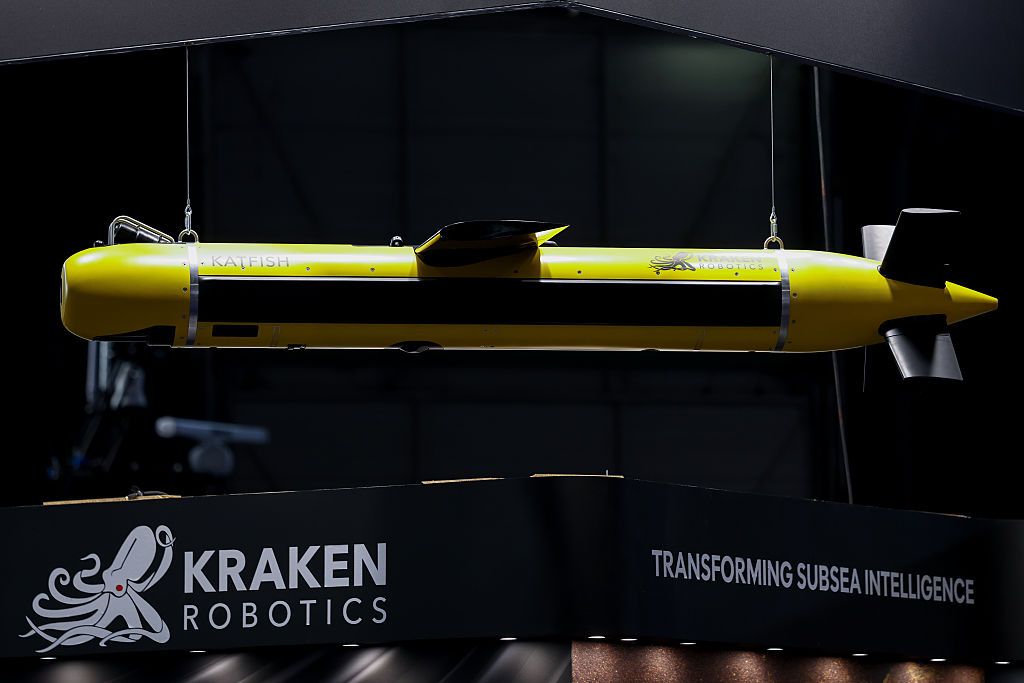
Canada’s makes equipment that helps its customers service underwater assets in a cost-effective way. Its products are used in commercial surveying, offshore energy and defence. Defence is an important catalyst for growth, but the same technology can be used to inspect cables, survey seabeds and monitor offshore infrastructure.
Modern economic life depends heavily on infrastructure that almost nobody ever sees. More than 95% of international internet traffic travels through fibre-optic cables resting on ocean floors. Gas pipelines and power interconnectors cross the world's seas. Offshore wind farms require regular seabed surveys and cable inspections, while oil and gas platforms need constant structural monitoring. Navies must identify submerged mines and protect critical sea routes.
For decades, inspecting and maintaining these assets meant chartering heavy support vessels and sending divers into the water. That approach is expensive and difficult to scale. Operators are turning towards uncrewed surface vessels and autonomous underwater vehicles that can survey the seabed with few or no people on board and stay underwater for days. The engineering challenge is considerable. This is the market in which Kraken Robotics operates.
Start your trial of MoneyWeek today
Get unparalleled financial insight, analysis and expert opinion you can profit from.
Start your trial
Sign up for MoneyWeek’s free twice-daily newsletter.
Join more than 165,000 subscribers and keep yourself informed with latest financial news, insights and expert analysis to help you understand what really matters when it comes to your finances.
Join more than 165,000 subscribers and keep yourself informed with latest financial news, insights and expert analysis to help you understand what really matters when it comes to your finances.
The market is expanding. The questions for investors are whether Kraken can turn that growth into a large, profitable and cash-generative technology business and whether the shares already assume too much success.
Kraken Robotics' highly valuable acquisition
Overcoming the considerable engineering challenges involved and their integration into innovative products has created a useful barrier to competition for Kraken Robotics. Once a company has decided to buy its systems, it's costly and difficult to switch suppliers. A successful sale can therefore lead to relationships that last for years. But winning individual component contracts is only part of the challenge. Kraken needs a much larger sales operation if it is to capture a meaningful share of the expanding subsea market.
In March 2026, Kraken Robotics agreed to acquire Covelya Group for C$615 million (£325 million). Kraken Robotics began as a Canadian specialist selling individual pieces of subsea equipment. Covelya gives it a much broader product range and a bigger international customer base.
The largest part of Covelya is Sonardyne, which specialises in underwater communications and navigation. Its equipment is used in offshore energy, ocean science and naval applications. Another part of Covelya, EIVA, adds hydrographic survey software, navigation tools and data processing.
Sonardyne and EIVA complement Kraken's existing products because they address different parts of the same underwater work flow. A customer surveying an offshore wind farm needs to know where its vehicle is, power it for the mission, collect detailed sonar data and turn that information into something useful. Before the acquisition, Kraken could supply some of those pieces. With Covelya, it can potentially supply much more of the system.
The deal should also give Kraken Robotics access to sales channels that would take years to build from scratch.
Sonardyne already has established relationships with commercial and government customers around the world. Kraken can use those relationships to introduce its sonar and battery products, while Covelya can potentially sell its own products through Kraken's existing channels. There is, however, a substantial price to pay. The C$615 million purchase required C$125 million of debt facilities and a sizeable issue of new shares, diluting existing shareholders. Kraken is also taking responsibility for a much larger organisation, including British manufacturing facilities and European operations.
Kraken Robotics has identified C$10 million of potential cost savings. Investors should treat these as targets rather than profits already earned. Integrating different engineering businesses can take up management's time, while cross-selling products between companies is harder in practice than it looks on an acquisition presentation. The deal increases the opportunity, but it also raises the risk.
The financial case is where the story becomes more complicated. The fiscal year 2027 will be the first full year to reflect Kraken's acquisition of Covelya. The enlarged group is expected to generate revenue of roughly C$570 million and adjusted Ebitda of around C$140 million. That represents a substantial increase in scale, although much of the step-up comes from the acquisition. The underlying business is also growing rapidly, helped by rising demand for subsea technology across defence and commercial markets.
The problem is that Ebtitda, a measure of operating earnings, is not cash. Kraken operates in an industry where growth itself can consume large amounts of working capital. Building sophisticated sonar systems and battery packs requires components to be ordered before the customer pays. Long-lead items such as titanium, acoustic ceramics and battery cells can sit in inventory or works in progress for months. Large contracts can also involve staged payments linked to delivery and certification.
Capital expenditure adds another drain on cash. Kraken is expanding its battery manufacturing capacity in Germany and needs to invest in survey systems and other specialist assets. These investments may support future growth, but they still have to be paid for today. A company can report rising Ebitda while shareholders continue to fund inventory, factories and equipment. Eventually, however, those investments have to generate cash.
There is a potential second source of cash generation from Kraken's growing base of equipment already in use. Underwater equipment operates in harsh conditions and requires maintenance and replacement. Batteries eventually need replacing, while sonar equipment can require servicing. EIVA also provides software that can generate recurring licence revenue. That opportunity should not yet be treated as established annuity income. Kraken's legacy business remains heavily influenced by large equipment orders, which can lead to lumpy results. The after-market opportunity should become more important as the amount of equipment in use grows and Covelya's service relationships are brought into the group.
Until then, Kraken has to finance a considerable amount of its own expansion. The key question is whether the enlarged group can generate enough cash to fund growth and reduce debt without repeatedly returning to shareholders.
What are the shares pricing in?
At an enterprise value of roughly C$1.5 billion-C$1.6 billion, Kraken is valued at around 11 to 12 times forecast adjusted Ebitda of C$140 million for the fiscal year 2027. That is closer to the valuation of an established defence contractor than a specialist instrumentation business. That comparison may understate Kraken's potential. The company has substantial exposure to defence, but its products also serve offshore energy, marine surveying, infrastructure inspection and other commercial markets.
Its growth rate may also be higher than that of more established defence businesses. If the enlarged group can sustain strong organic growth alongside the benefits of the Covelya acquisition, investors may eventually value it more like a specialist instrumentation company.
There are still reasons for caution. The current valuation assumes that Kraken delivers substantial growth, integrates Covelya effectively and achieves the planned C$10 million of cost savings. It also assumes that working capital becomes less demanding over time. If inventory remains high, battery investment continues to consume cash, or integration takes longer than expected, the gap between Ebitda and free cash flow could remain wide. The valuation may therefore prove attractive if Kraken delivers its forecasts and converts a meaningful proportion of Ebitda into cash. If cash conversion moves towards 50% of Ebitda, debt is paid down and after-market and software revenue become more important, the shares could look inexpensive relative to the quality and growth of the enlarged business. If Ebitda continues to be absorbed by inventory and investment, however, the shares will offer less protection than the headline multiple suggests.
Two paths lie ahead for Kraken Robotics
The favourable case is straightforward. Kraken integrates Covelya without losing key staff or customers, sells more products through the enlarged group and delivers its C$10 million in savings. Sonar, battery and software sales grow together, while the installed base begins to generate more recurring service revenue. Working capital becomes less demanding as production and billing processes mature. Cash generation then allows Kraken to reduce debt and fund further growth without issuing more shares.
The other path does not require the business to fail. Integration could take longer than expected, naval orders could be delayed and offshore energy spending could become less predictable. Inventory and milestone payments could continue to absorb cash. If free cash flow remains weak while Kraken keeps investing, the company may need to raise additional debt or equity. In that situation, even strong revenue growth may not translate into attractive returns for shareholder.
Kraken operates in an interesting part of the technology market. Its sonar, batteries and subsea systems address genuine problems created by the growing use of autonomous vehicles and the need to inspect infrastructure beneath the sea. Defence spending provides an important source of demand, but the opportunity extends well beyond defence.
Covelya makes the story more interesting. It gives a Canadian specialist a substantial British engineering business, established customers and a broader range of products that could fit together into a more complete subsea technology offering. If management can make that combination work, Kraken could become much more than a collection of component businesses.
Having fallen in value in the last year or so, the shares no longer appear expensive. At an enterprise value of roughly C$1.5 billion-C$1.6 billion, Kraken trades at about 11 to 12 times forecast adjusted Ebitda for the fiscal year 2027. That is closer to the valuation of an established defence contractor than a specialist instrumentation business, despite Kraken's broader commercial exposure and potential for growth. This could create an opportunity if the market continues to value Kraken primarily as a defence-related business. Successful integration, sustained organic growth and better cash conversion could support a higher rating over time. The reverse is also true. If working capital remains demanding, debt stays elevated and Ebitda continues to be absorbed by investment, the shares may struggle to reflect the potential of the enlarged group.
For now, Kraken looks like an impressive engineering business with an unusually large opportunity. The most important evidence will be whether Kraken can convert its growing earnings into free cash flow without repeated appeals to shareholders.
This article was first published in MoneyWeek's magazine. Enjoy exclusive early access to news, opinion and analysis from our team of financial experts with a MoneyWeek subscription.