'Tequila?" says a woman brightly, proffering a pink plastic shot glass. It's barely 10.30 on a Saturday morning, and my perimenopause wellness journey is not going entirely as expected. We are standing in a neon-lit London conference centre amid the hubbub of Pause Live, billed as the UK's biggest annual women's health and menopause event and essentially a consumer fair for those in midlife. All around me, women are sampling free squirts of menthol lotion (supposed to cool hot flushes) and paper thimblefuls of slightly grainy, sweet latte made with powdered Peruvian maca root instead of coffee.
The tequila, it turns out, is a gift from the sponsors, with no miracle ingredients beyond alcohol. But stalls offer everything from neck creams to pelvic-floor trainers, mindfulness journals and hairpieces for disguising thinning locks, plus herbal supplements in every conceivable edible form: chocolate truffles, ginger shots, mushroom coffee. (Fungi are big news in the menopause wellness world, often touted as an answer to brain fog. Though at best the scientific jury is still out, Ocado searches for lion's mane mushrooms more than quadrupled after an episode of Clarkson's Farm in which Jeremy Clarkson's partner, Lisa Hogan, persuaded him to grow them to make supplements, claiming that "everyone who's anyone" is on them.)
There are panel discussions about getting your confidence back at work, a prosecco bar and a hula‑hooping session. A woman selling pairs of magnets that clip to your knickers swears they helped with her hot flushes. Though she is somewhat vague about how exactly "the magnetism gets into your bloodstream", she's commendably frank about the downside: she has to take off the pant magnets to do a food shop, for fear of sticking to the metal supermarket trolley.
As the tagline for Stripes Beauty, the actor Naomi Watts's new wellness brand, puts it: "Welcome to a world where menopause isn't a dirty word." But has it become an overused one instead?
The global perimenopause market is projected to be worth up to $25bn by 2030, according to the consultants PwC, as pharmaceutical companies catch up with the previously underserved health needs of women whose periods are drawing to an end. But it's the consumer side of the market that is growing most rapaciously, as brands churn out menopause-friendly versions of everything from shower gel and herbal tea, to cooling pillows and toothpaste (less daft than it sounds, given perimenopause is linked to shrinking gums and tooth loss). The consumer magazine Which? has meanwhile warned that in some cases women are paying a "pink tax" premium for standard products, from moisturiser to vitamins, that manufacturers have discovered can be sold at a higher price if rebranded as specifically for menopause.
"Companies have realised that middle-aged women have money. And they've also realised that we are maybe going through a tricky time – kids leaving, navigating long-term relationships, looking after parents … I think they see a little window of vulnerability, both with menopause symptoms and other symptoms of ageing," says Joyce Harper, professor of reproductive science at UCL and author of Your Joyful Years: Empowering Good Health and Happiness Beyond 50. A paper she recently co-authored for the journal Climacteric reviewed more than 200 menopause supplements and found wide variations in ingredients and price, suggesting an unusual lack of consensus about what – if anything – works. (Nearly half didn't even contain vitamin D, which, along with calcium, is the only supplement with sufficient proof of efficacy to be recommended by medical experts in menopause, and then only for bone health.) The paper concluded supplements were being sold to menopausal women "despite the limited empirical evidence currently available" that they actually worked, prompting Harper to warn of a "menopause gold rush" in which women risked being exploited.
Yet even with her professional expertise, she acknowledges it's not always easy to resist the social media hype. "I've got a dodgy knee, and every now and then my algorithm sends me, 'Oh, this cream is going to sort you out', and every now and then I click on it," she admits. "I get that close to thinking, 'It's only £20, might as well try it.' And I've been researching this for yearsI don't blame any woman for being sucked in."
That women are now queueing up for products advertising their perimenopausal status, rather than suffering in embarrassed silence, is arguably progress of a kind. It suggests a stigma lifting, and a market finally taking older women's needs or desires – not to mention their spending power – more seriously. However, with that welcome change has come concerns about "menowashing", or brands using women's health needs to sell them things they don't need at a potentially vulnerable time. Who, exactly, is this market serving?
For many of the women I meet at Pause Live, it's more about a fun day out than a search for miracle cures. Helen, 61, is off out dancing later but has dropped in here first because, "I'm really into wellness and health," she says. She runs an Instagram account about ageing stylishly called Silversparkles1965, and says she could have done with something like this years ago when she was going through menopause. "I'm on HRT now but I'll take anything that works," she says. Her friend Marina, 55, nods vigorously, adding: "It's wonderful that now it's being acknowledged."
But not everyone is simply here for a good time. Ali Stripling, a workplace coach and motivational speaker, was plunged into early medical menopause after treatment for anal cancer. "I'm interested in pelvic health, sexual wellness, breaking the stigma that has been around midlife. There's a lot of menowashing here," she says. Her friend Georgia Swift, who works for the NHS, says she has had an "amazing facial" but is disappointed there isn't more on mental health.
Anxiety, depression and loss of confidence are all common in perimenopause, and it's not just hormones that can make this time a vulnerable one. Midlife is also the season of children leaving home, parents dying, the creeping suspicion that your boss would like to trade you in for someone younger, and, for some women, a feeling of being dismissed by wider society. It's precisely that anger that some brands are latching on to.
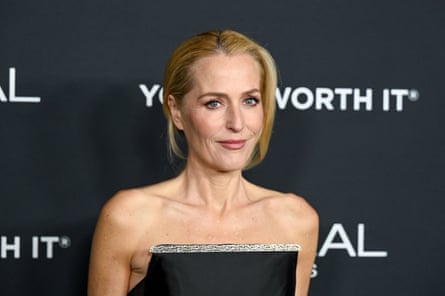
The cosmetic giant L'Oréal recently launched a campaign featuring the 58-year-old actor Gillian Anderson lashing out at the way women over 50 are made to feel invisible: "Even if you think I'm easy to dismiss as an angry menopausal feminist, the fact is I have never felt better. I've never felt more alive in my skin, clear-headed, purposeful, free of self-judgment." Anyone who doesn't accept her right to take up space in the world can, she says scathingly to camera, just "fuck off". Perhaps the wellness industry's most seductive promise to this age group isn't eternal youth, but the feeling of being cared for and taken seriously – even if it is by a wrinkle cream.
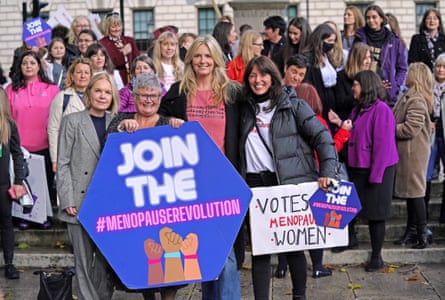
According to a survey of Mumsnet users this spring, 68% do not think the NHS takes women's health in general seriously, and 64% report having been told their symptoms were either normal or "in their head". More than half say the NHS is institutionally misogynist. "It doesn't matter how many reports or inquiries we have [if you don't] grapple with the culture – which is women being constantly dismissed, their pain and their symptoms being dismissed," says Justine Roberts, the chief executive of Mumsnet. "Half of them said they don't even bother seeking care because they won't be taken seriously. We don't have nearly enough research on hormones in menopause and what HRT means for later life outcomes." The lack of perimenopause training for doctors is, she says, driving women to look elsewhere for help with symptoms. "Social media is filling the gap." But platforms full of influencers being paid to post gushing praise for products is the last place to look for disinterested information.
In his new book, Make Me Well, the doctor turned broadcaster Xand van Tulleken argues that "Big Menopause" first took off as an industry back in 1990, when studies linking HRT to breast cancer prompted frightened women to seek other ways of coping with the hormonal transition around the end of their periods. (Even now, although research suggests the cancer risk is smaller than originally thought and outweighed for some women by other benefits, only about one in seven British women takes HRT). Sales of herbal remedies such as evening primrose oil, black cohosh – thought to help with hot flushes, though it has subsequently been linked to liver damage – and red clover surged, fuelled often by word of mouth between friends. Three decades on, social media has supercharged that process, though now supplements are often promoted as a boost alongside HRT rather than an alternative.
I usually scroll straight past the junk ads on Instagram for supposedly menobelly-reducing diets with which women over 40 are bombarded. But I click on a few while researching this piece, and the algorithm instantly responds. It's like opening a portal to another universe, full of female celebrities in their 50s raving about creatine powder (Davina McCall, presenter of a viral Channel 4 documentary on menopause, who says she uses it to combat midlife muscle loss) or gut health supplements (Mariella Frostrup, broadcaster and menopause awareness campaigner) or drinkable collagen (the actor Kate Winslet). After several days of this, a small seductive voice starts to whisper in my cynical ear: well, maybe there's something in it?
When I ask friends, acquaintances and Bluesky followers, I'm amazed at how many smart women somewhat sheepishly confess to having experimented with things like anti-bloating skin patches ("I can't believe I'm admitting to this in public"), energy-boosting maca powder ("expensive dust"), home hormone testing kits ("mad expensive and not that useful") or a £30 serum to rebuild thinning eyelashes.
"I know better. We all know better. But you just think, 'It can't hurt to try'," groans Sam Baker, host of The Shift podcast and Substack for midlife women. Having just cancelled all the supplements she was taking, Baker says so far she has noticed precisely "no difference". So why do we keep on falling for it?
For the unlucky 25% of perimenopausal women experiencing severe or debilitating symptoms, desperation may be part of the answer. But most of the marketing I see seems to be targeting the other three‑quarters, encouraging them not to settle for anything less than the energy levels or skin elasticity they had when they were younger. It's hard to work out whether it's perimenopause they're claiming to solve, or age itself.
Menopause-friendly branding has in some ways taken over where "anti-ageing" left off, Baker points out, as beauty brands in particular respond to a backlash from customers against the idea that there is something innately wrong with getting older. "The companies have listened. They have found a different word for it. But we are still trapped in this place where if you are a woman getting older, there are two ways to do it and they're both wrong. You either go grey and go quietly into that good night, or use everything possible to stop it, and both of those things are open to criticism." For all Gillian Anderson's fighting feminist talk in the L'Oréal campaign, she's still the face of its Age Perfect range of creams to combat sagging skin and wrinkles.
The ads I find most seductive aren't the ones about rolling back the years; they're the ones carrying the soothing, flattering message that as a busy woman I must have a lot on my plate, so why don't I just put myself first for once. It's the siren call not of anti‑ageing but of self-care, targeted at women who feel they have spent decades putting their children's or their partners' or their ageing parents' needs first, and are now beginning to wonder if anyone is ever going to do the same for them.
he air conditioning inside Heather Jackson's pop-up store on Kensington High Street is turned up refreshingly high, and the music dialled down low enough for middle-aged ears to hear a conversation. Aromatherapy scents waft over us as she walks me through the carefully curated shelves: moisture-wicking pyjamas for easing night sweats, low-temperature straighteners designed to be kinder to thinning hair, body lotions for skin that is suddenly drier than it used to be, and neatly serried rows of the inevitable menopause supplements. It's a luxurious concept store, designed to show retailers what prioritising their perimenopausal customers might look like in practice. Compared with the nearest busy branch of Boots, where I eventually find two shelves of menopausal health products in the basement, sandwiched between the Nicorette gum and the thrush cream, it makes the end of your periods feel practically aspirational.
"I wanted to create something like when I was a child and went into Hamleys and it was all for me," says Jackson, an immaculately groomed but down-to-earth Yorkshirewoman whose background is in corporate talent development and getting women into senior roles. (Research suggests one in 10 women aged between 40 and 55 have quit a job because of menopause symptoms, she points out, just as they should have been hitting their professional peak.) Sh e founded the brand partnership GenM after struggling to find practical perimenopause-friendly products – like foundation that didn't melt in a hot flush – to get her through her own menopause seven years ago. Its MTick symbol, inspired by the V for vegan-friendly logo, now appears on the packaging of more than 170 member brands in high street stores from Tesco to Boots. It's not proof of efficacy – GenM doesn't do its own independent testing – but brands are at least required to show evidence of their workings when making claims about menopause.
The idea, she insists, is to help women seek out better-tailored versions of the products they would normally use, rather than settle for the ones they have always bought. "I want more women to wake up and go: we fought hard, and just when we're about to peak we're letting ourselves say, 'It's not about me any more.' Well, it about you. If we can't have our best life now, when can we have it?"
Surely in the end it's about driving sales? "Money makes the world go round. I'm not ever going to dispute the commercialisation of menopause. But money driven purposefully can make society change."
Though Harper dismisses MTick as merely "amazing marketing", Jackson insists her process is rigorous enough that some big brands have failed to pass. "I didn't want menowashing and exploitation, I wanted choice and trust," she says. "Women of our generation, we've been exploited all our lives."
For those who can afford it and have a realistic idea of what it's likely to achieve, a special menopausal hair mask seems no more unreasonable a purchase than a bunch of flowers or a nice coffee, or anything else women buy to cheer themselves up after a rough day. If something works for you – and plenty of women swear by alternative menopause remedies, including those for which there's zero clinical evidence – does it really matter if it's just a nicely packaged placebo? (One 2015 study on placebo effects in treating hot flushes found a third of the group given the dummy pill saw a significant improvement in their symptoms after eight weeks, which for some lasted weeks after they stopped taking it.)
Placebo effects can, Harper concedes, be powerful. "There are some studies that show if you just take part in a study, you do better – because someone cares." But her advice to women is always to stop, think and Google for the clinical evidence first before buying. "I want to empower women with the correct information, and when I see women with misinformation going down some rabbit hole, it makes me very sad."
Women should also be aware, she argues, that relying on the wellness industry rather than conventional medicine can be risky. Ingredients in some supplements can interact with prescription drugs, while self‑diagnosing symptoms from depression to joint pain as simply the effects of perimenopause may mean missing another underlying illness that needs treatment. "Her joints might be hurting because she's got osteoarthritis. Her lack of energy could be her thyroid."
What many women really are missing out on, Harper says, is the one menopause remedy that's not only backed by decades of robust clinical evidence but often free or cheap: lifestyle medicine like exercising, eating well and moderating alcohol intake, which might not cure serious symptoms but should at least be the first line of defence. "If you do all the good things – no short cuts, no quick fixes – there's so much scientific evidence that you will feel better. But the biggest thing when you get to this age is the realisation that you will lower your risk of all the chronic health conditions: cancer, diabetes, heart disease, dementia," she says, emphasising that this advice applies to women on HRT as well as those who can't or don't want to take it.
"My motto this year is to make lifestyle medicine . I don't see it as a chore to cook a lovely meal when you get home from work. Tonight I'm going to go do BodyAttack and yoga, and I can't wait – I just love the buzz. But everyone's got their thing, whether it's going for a walk in nature, a wild swim, putting some music on and dancing round your kitchen for 10 minutes – and all these things are pretty much free.
"Paying £100 a month for some supplement? Spend that money on going to have a blooming massage."