Britain has successfully sold more government debt this morning, but at the highest price since the financial crisis almost two decades ago.
The Debt Management Office sold £4.5bn of 5-year debt at an average yield of 5.036%, the highest since 2008, .
There was plenty of interest in the gilts – perhaps not surprising, given the lucrative yields the DMO was prepared to pay. Investors bid for 3.51 times as much debt as was available, allowing the DMO to pick the best offers (ie, the investors offering to accept lower yields).
The UK stock market is hoping for a budget that "does no harm", reports manager of the Schroder Income Growth Fund.
That may sound rather unambitious, but after two tax-raising budgets from Rachel Reeves the City would prefer a fiscal event that was light on fireworks, but with some growth-friendly measures.
explains:
After two years in which businesses have absorbed significant increases in costs and taxation, another broad increase in the corporate burden would risk undermining the investment and growth the Government wants to encourage.
"There are, however, areas where policy could make a positive difference. For housebuilders, we will be looking closely at the detail of the Your First Home scheme and whether it can provide a meaningful stimulus to new-build demand and housing supply. More broadly, additional investment channelled through public financial institutions into areas such as infrastructure, defence, AI and energy could create opportunities for UK-listed companies, particularly if it succeeds in crowding in private capital.
"Ultimately, UK companies need greater policy stability and confidence to invest. A relatively uneventful Budget that delivers that would not be a bad outcome."
We have some better economic news from the US.
US consumer confidence has risen in October for the first time in four months, as Americans grow more optimistic about the job market and business conditions.
gauge increased 7.5 points to 91.7, the highest since June and beating forecasts.
"Consumer confidence advanced in October, driven primarily by improved perceptions of current and expected business conditions," said , senior economist, global indicators at , adding:
"The recovery was in line with retail gasoline prices easing from September to October. Yet, despite the increase in October, consumer confidence remained on the long-term downward trend that's persisted over the past few years. Consumers planned less spending on services and durable goods over the next six months. This likely reflected higher price levels and persistent inflation, which eroded consumers' purchasing power."
Britain's logistics industry has been cheered by reports that chancellor John Healey will retain the current freeze on fuel duty in tomorrow's Budget.
This wouldn't be a terribly surprising development – it's become a modern tradition that a chancellor lays out plans to raise fuel duty in future years, only to bottle it when the moment arrives.
, chief executive of business group says:
"Logistics businesses across the UK will be hoping that today's media reports about the continued freeze in fuel duty prove to be accurate. Retaining the current 5p per litre cut in tomorrow's Budget would be a pragmatic measure that keeps trade moving, supports growth in every postcode and avoids adding further inflationary pressures at a time of rising costs for consumers and businesses. We believe the case for maintaining the current Fuel Duty rate is clear as businesses continue to face significant cost pressures and economic uncertainty."
Back in the markets, Wall Street has opened higher as tech stocks rebound from their recent losses.
The share index has gained 1%, up 250 points at 26,420 points. AI cloud computing operator Nebius is leading the risers, up almost 9%.
The 500 share index is up a more modest 0.5%.
The rise in government bond yields has been driven by inflation fears, due to the jump in the oil price this year.
And there are encouraging signs today that energy prices are falling.
Brent crude is down 1.6% at $113.91 a barrel, driven by a diplomatic push to de-escalate tensions between Saudi Arabia and Iran.
Yesterday, representatives from Saudi Arabia, Turkey, Pakistan and Iran met in Tehran; Iran's Foreign Minister Esmaeil Baqaei said the talks were a step toward regional security cooperation.
According to Reuters, Iranian Security Council chief Mohsen Rezaei on Tuesday met Supreme Leader Ayatollah Mojtaba Khamenei, with state media reporting that Khamenei had emphasised the importance of pursuing Iran's interests and maintaining its conditions for ending the war.
Over in the US, new home sales have stumbled as Americans have wrestled with higher interest rates.
New single-family home sales decreased by 0.6% in September to an annualized rate of 676,000, according to figures released today by the federal government.
If Chancellor Healey can deliver the dull budget the market expects on Wednesday then the UK will be rewarded with lower gilt yields, says , investment director, rates management at
"It's been a year of negative gilt headlines. The rise in oil and gas has put pressure on gilt yields, which has impacted everything from Government borrowing to mortgages. In all this negativity what hasn't been reported is that gilt yields have surprisingly held up okay. When we look at gilt yield moves we don't simply view them in isolation. We have to view them vs our US and European peers. If UK yields move in isolation, the UK has a problem. If yields move in line, yes the yield move is a negative but it's a global story.
Since the political volatility of May, gilt yields have been relatively well behaved. Against both Germany and US, gilts have remained in recent historic ranges. The big move has been against France. If Chancellor Healey needs any reminder of what can happen to gilt yields if you lose control of the fiscal message then the French OAT move is exactly that. In May, UK 10 year yields were approximately 1.30% higher than French yields, going into the budget they now trade only 0.30% higher; a huge move.
The UK bond market is pretty quiet ahead of tomorrow's budget.
The yields on long-dated gilts are down slightly, having already dropped back from the multi-year highs struck earlier this autumn.

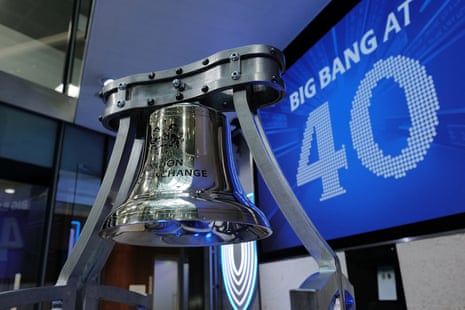
London's stock market has been marking the 40th anniversary of the Big Bang – the sweeping, Thatcherite deregulation of the London Stock Exchange.
The Big Bang brought several fundamental changes to the City, including the end of fixed fees for share trading, allowing firms to operates as both brokers and market-makers, and bringing in electronic trading.
It also allowed foreign firms to buy UK stockbrokers, paving the way for the takeover of UK banks by (largely) American rivals.
To mark the occasion, this morning's opening ceremony at the London Stock Exchange rang its new bell for the first time. This bell, the LSE says, is "a symbol of its heritage, ambition and the market community."
It's unfortunate that the market promptly fell by 1%, but we can blame HSBC for that!
"I think the market will want a relatively dull budget with credible fiscal control, sensible spending commitments and greater breathing space. There is very little room for error here. With gilts yielding 5.35% 10-year, inflation proving sticky and the Bank of England remaining concerned about inflation, the market will not look kindly at any sign of slippage. I don't think we should get too excited by the yield fall recently. It appears to be being done more as a precaution.
"Investors will want crystal-clear transparency. The extra £20.4 billion of funding proposal for the National Wealth Fund and the British Business Bank could help to boost long-term growth, but as borrowing is not expected to begin until 2028-29, this should not cause any issues for gilts. Investors will still want to know what borrowing needs are going forward, the credit risk and if the investments actually give value for money. As long as this is properly accounted for and is financially credible, then the markets should be comfortable. However, if it is seen as an exploit or abuse of accounting rules to disguise fiscal risks, gild yields may rise high again."
UK borrowing costs could come under more pressure if bond investors are unimpressed by tomorrow's budget.
The City is expecting a "low-key, low-vol event", to quote analysts this morning.
Investors are expecting a drop in the UK's fiscal headroom (the margin to keep within the borrowing targets), to around £15bn to £20bn, down from £23.6bn in March.
To achieve that, Healey will have to demonstrate spending restraint kicking in towards the end of this parliament, but the big questions about government spending will probably have to wait until next year's Spending Review.
say investors expect this Wednesday's budget to keep the government's fiscal consolidation plans on course, warning there is "a risk of a jump in yields if Chancellor Healey announces more borrowing than investors expect on 28 October."
Over in France, consumer confidence has dropped to a 13-year low.
The monthly consumer morale gauge produced by statistics body INSEE fell from 85 points to 80 this morning, below forecasts.
INSEE said "household confidence has strongly worsened" this month, with people more pessimistic about their personal financial situation
The proportion of households believing it is a good time, in the current economic situation, to make major purchases fell, as did gouseholds' opinion on their future ability to save.
Accountancy firm EY UK has lifted the pay of its partners by over 10% to £870,000.
The increase is twice as large as the 5.2% average pay rise for EY employees last year.
EY's partners are paid from its distributable profits, which rose to £702m before tax in the last financial year, up from £679m.
The firm has also boosted its staff bonus pot by 25%, and reported reported that its UK fee income rose by 2% to £3.86bn in the financial year ending on 3 July 2026.
Anna Anthony, EY UK & Ireland regional managing partner says:
"These are a solid set of results in a challenging market. We've continued to grow the business, while making significant investments in talent and technology to support our future growth and deliver high quality and innovative services to our clients.
"In FY26 alone, we hired 2,300 people across all parts of the UK, made over 3,700 internal promotions and progressions and announced a significant evolution of our global Alliance with Microsoft.
"We also recognised the contribution and performance of our people with our largest variable pay pool to date, whilst continuing to invest in training and development, with over 1.2m learning hours completed.
"With economic uncertainty, technological transformation and shifting expectations of business reshaping every sector, I'm proud of the steps we've taken to position our firm for the future while continuing to deliver for our clients, people and the communities we operate in."
Britain has successfully sold more government debt this morning, but at the highest price since the financial crisis almost two decades ago.
The Debt Management Office sold £4.5bn of 5-year debt at an average yield of 5.036%, the highest since 2008, .
There was plenty of interest in the gilts – perhaps not surprising, given the lucrative yields the DMO was prepared to pay. Investors bid for 3.51 times as much debt as was available, allowing the DMO to pick the best offers (ie, the investors offering to accept lower yields).
The jump in interst rates which has boosted bank profits is also weighing on the housing market.
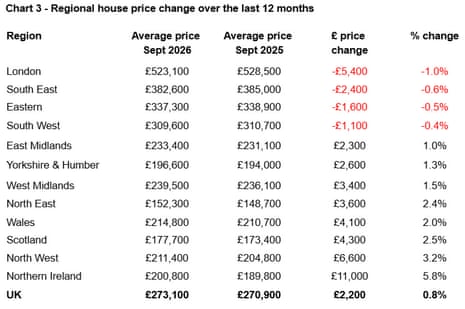
Zoopla has reported this morning that 35% of UK homes are in postcode areas where house prices are falling, up from 12% a year ago.
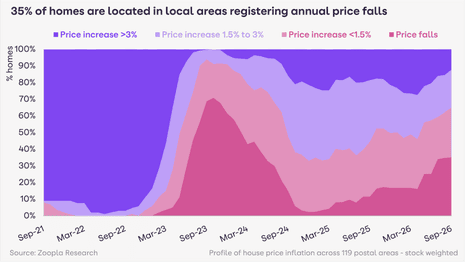
These price falls are "concentrated in London and the South East", it says, where 85% of homes are in local markets with price falls.
This trend is due to higher mortgage rates which have increased the cost of buying and made buyers more selective – the number of sales agreed over the last four weeks is seven per cent lower than a year ago across the UK.
executive director at , says,
"The extra cost of mortgages has made home buyers more selective while greater choice of homes for sale has increased the scope to negotiate on price. The impact is being felt by sellers in southern England where house price falls are most concentrated as average prices continue to rise across the rest of the country.
"There is still demand to buy homes, and those that are well priced and presented are selling just as quickly as last year. Getting the price right from the start is essential. Overpricing significantly reduces the chances of selling, so sellers should seek advice from local agents on buyer demand and the right asking price for their home."
Although HSBC has been raking in the profits, smaller businesses are finding life rather tougher.
The number of UK businesses in 'significant' financial distress has hit a record high of 738,144, according to the latest Red Flag Alert research from financial group BTG. That's the highest level since the report began in 2004.
BTG found that the highest volumes of firms strugging operate in support services, construction and real estate and property services.
managing partner at , says its a worrying sign ahead of the budget:
"Record levels of 'significant' financial distress underline just how many businesses are approaching the Autumn Budget with limited financial headroom. While firms will naturally be looking for clarity on taxation and economic policy, many of the pressures they face extend well beyond any single Budget announcement.
"My real concern is for consumer-facing sectors such as leisure and hospitality, particularly as we enter the run up to the vital Christmas trading period. Higher employment costs, rising inflation and interest rates will add real-world pressure to many domestic budgets. Add into that a forecast 26% rise in the January 2027 energy price cap and households are likely to concentrate on the essentials.
We'll find out in around 28 hours what new taxes the chancellor has decided to impose on the UK banking sector.
These pictures from the Treasury show John Healey preparing for the budget in his flat in Downing Street in recent days:
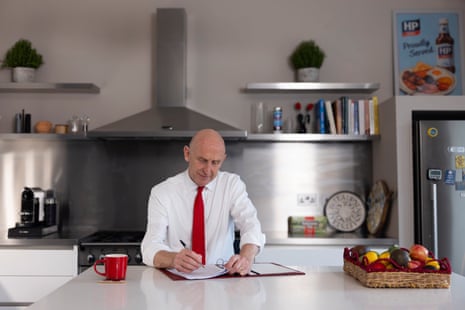
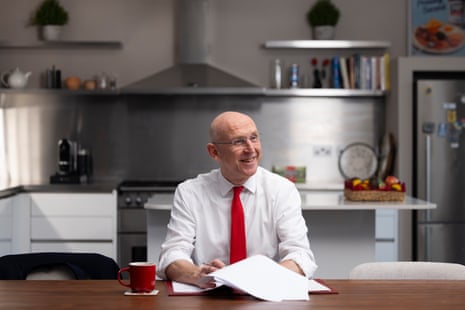
You'll note there appears to be a bottle of HP sauce behind Healey's left ear, as the chancellor moves between his kitchen island and the dining table.
Frankly I'm surprised it's not closer. The chancellor is rather fond of a dob of brown sauce, and even carries a bottle with him.
The Times reported that last week he bought a sausage roll from Greggs, pulled a bottle of HP Sauce from his briefcase and "permitted himself a moment's indulgence" after announcing the approval of the Jackdaw gas field in the North Sea.
HSBC CFO's, Pam Kaur, was asked by reporters why the bank's shares were down today (they fell in Hong Kong first, and then in London).
suggested some reasons:
"I think in a high interest rate environment, there's sometimes a market expectation that we upgrade guidances or we change our targets, and particularly from a banking NII perspective. So that's all I can think of."
"HSBC's third-quarter results have fallen a little short of market expectations. Revenue was weaker than anticipated, with pressure on net interest income and a slowdown in wealth, and that disappointment has translated into a slide in the share price.
"The numbers themselves are not disastrous. Profitability remains strong, with an 18.2% return on tangible equity, while loan losses were better than expected and HSBC has reiterated its target of delivering returns above 17% over the next three years. The bank is also returning another $1bn to shareholders through a buyback.
"The issue is that HSBC has set a high bar for itself. Following a strong run for the shares, investors have become accustomed to robust results, so even relatively modest misses can prompt a sharper reaction. Today's fall therefore looks more like disappointment against high expectations than a significant deterioration in the underlying business."