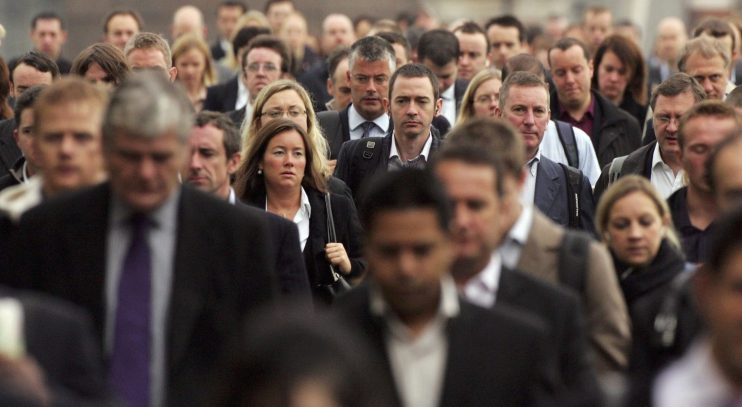
Professionals have drifted left since the 1970s, but an economic squeeze gives the right a chance to win them back, says Natasha Feldman
Reconciling the Red Wall and Blue Wall voters is one of the greatest challenges for the political arts today. For a long time now, the right has been in deficit amongst Blue Wall higher professionals. But there has been little attention paid to the granular detail of this phenomenon – and how to address it.
Policy Exchange’s new report, What Britain’s New Establishment Thinks… And Why It Matters, shows that, since the 1970s the higher professional class has shifted from right to left in its ideological attitudes and party alignment.
But the current economic squeeze on the higher professional class may yet reverse the gains made by the left and present a new opportunity for the right. This matters because even if the right does win again, it will struggle to govern without the support of at least a segment of the professional classes.
The professionals’ attitudes are now moving closer to those of the general population on meritocracy, immigration and welfare. The right therefore has a window in which to act.
Stay in the know
Three daily briefings with the key market moves and top business and political stories.
SUBSCRIBE HEREThe higher professional class grew from 1m people in 1981 to 4.7m in 2021, rising from four per cent to 12 per cent of the working population. The British Election Study (BES) shows that during this time professionals increasingly adopted progressive social attitudes, and eventually economic ones too.
Drifting left
Professionals’ voting patterns tell a similar story. In 1960s and 1970s Britain, higher professionals were happy to vote Conservative. In 1963, 66 per cent of higher professionals identified with the Conservatives, but this fell to 47 per cent in 1979 and recovered only to 50 per cent in the 1980s and early 1990s. Then came 1997 – a “watershed year”: Tony Blair and New Labour gave higher professionals a chance to have their cake and eat it. To vote with their “unselfish hearts while protecting their selfish pockets”, as David Goodhart writes in the report.
He attributes this shift to the expansion and diversification of the higher professional class, as well as to the forward march of higher education and the rise of the public sector professional in the civil service, health and education. The shift was also encouraged by many professionals in the private sector becoming dependent on public sector contracts.
Today, Focaldata polling shows that professionals remain significantly more progressive than the general population on many social issues. Nevertheless, there may be some “bridgeable” gaps, where the right could step in.
Both professionals and the general population agree that attempts to give equal opportunities to certain groups have, in some cases, gone too far. Both also think that employers should promote the most qualified person for the job, rather than promote someone to create a diverse team (+51 for professionals and +50 for the general population).
Both groups also say that efforts to cut immigration have not gone far enough and agree that Britain should deport foreign nationals convicted of violent crimes, even if they would face danger in their home country (+57 vs +65).
Since the 1970s, professionals have also moved from right to left on economic issues. Partly as a result of the class’s expansion and greater diversity, professionals today feel less secure and less special than they did a generation ago.
Then there is the economic pinch. For graduates, starting salaries fell four per cent in real terms over 20 years while the minimum wage rose 60 per cent, and many were saddled with heavy student loan debts. In the 1970s, 35 per cent of income tax was paid by the top 10 per cent of taxpayers, compared with 61 per cent today. The Institute for Fiscal Studies found that while in the 1990s almost no nurses and one in 16 teachers paid higher-rate tax, this would be more than one in eight nurses and one in four teachers by 2027-28.
Yet, the Focaldata polling found that professionals’ economic alignment with the left may now be weakening. Both professionals and the general population think that we should not “tax billionaires out of existence” (-13 for professionals and -4 for the general population) and that we should not have more welfare spending if it means higher taxes (-16 vs -15).
To capture the professional classes, the right has a case to make, for meritocracy in hiring and promotion, a new approach to immigration, and reducing welfare dependency
Moreover, both think we should provide benefits only for those who can prove they are actively looking for work (+55 vs +50), with professionals expressing stronger views on this issue.
To capture the professional classes, the right has a case to make, for meritocracy in hiring and promotion, a new approach to immigration, and reducing welfare dependency.
The question at the next General Election will be whether the growing economic concerns of the professional classes are enough to outweigh some of the cultural barriers to voting for parties on the right. The right must now craft an economic offer that is compelling enough to capitalise on this opportunity; the answer could define the future direction of British politics.
Natasha Feldman is a Research Fellow at Policy Exchange