Most investors will see past Saba Capital's disingenuous narrative that seeks to portray this New York hedge fund as a friend of the average investment trust investor. Let's be clear: the main priority of Saba Capital and its founder Boaz Weinstein is to close (ideally eliminate) the discounts – the gap between share price and net asset value (NAV) – of those investment trusts that it owns, as fast as possible.
It cares not a jot about the valuable nature of the investment trust structure, the fundamental attractiveness of the underlying assets or even the shorter-term performance of the portfolio in many cases, since with trusts that invest in liquid securities, it will be able to hedge any movements in these. It is simply looking to bring the share price and the NAV together. Everything else is moot.
How Saba Capital demonised investment trust discounts
A fascinating aspect of Saba Capital's attack on the sector is how it has championed a narrative that discounts are a wholly bad thing. This agenda has sadly had the backing of many investment trust brokers and has suited some larger wealth managers who are typically looking to exit, or at least lighten, their investment trust exposure. Saba has become the glue binding together those participants' short-term aims.
Start your trial of MoneyWeek today
Get unparalleled financial insight, analysis and expert opinion you can profit from.
Start your trial
Sign up for MoneyWeek’s free twice-daily newsletter.
Join more than 165,000 subscribers and keep yourself informed with latest financial news, insights and expert analysis to help you understand what really matters when it comes to your finances.
Join more than 165,000 subscribers and keep yourself informed with latest financial news, insights and expert analysis to help you understand what really matters when it comes to your finances.
Yet investment trusts and discounts (or premiums) are like peas in a pod – you cannot truly have one without the other. Of course, there are some trusts who game the system by doggedly buying and selling their shares to keep them hovering close to NAV. This feels a little like the fable in which a farmer raises an eagle among chickens and wastes its potential. If keeping NAV and price in line is crucial, why not just become a unit trust (one of the chickens!)?
One of the great advantages of investment trust shares trading at a discount to their underlying asset value is that investors can buy 100p of assets for 90p. If the discount doesn't budge, the investor gets no capital benefit from this. However, they still gain an income advantage, in that they receive the income produced from the 100p of assets having only invested 90p. This can be further enhanced if the investment trust takes on modest borrowings.
A less well understood tool that can be used by investment trust boards when their shares are trading at a discount is the judicious use of share buybacks. This is not a panacea and is dependent on the liquidity of the underlying assets held by the trust. However, it can become very accretive to shareholders over the years. If a board buys back 5% of the outstanding shares over the course of a year at an average discount of 15%, this enhances the NAV by around 1% – effectively offsetting a typical fund manager's annual fee. In this light, are discounts really so bad?
Forced liquidation of assets
Saba's urgency to extinguish discounts has some nasty effects. The greatest of these is the forced liquidation of assets with little regard to their future return potential. Saba deliberately focuses on investment trusts with wide discounts where disaffected large shareholders are looking to sell blocks of shares. Many such trusts were investing in smaller and medium-sized companies, which have been out of favour following many years of under-performance versus larger companies. We see such stocks as strong candidates for delivering
Saba Capital's Boaz Weinstein outsized future returns given their historically low valuations. It is quite likely that future returns from holding this sector will far exceed any short-term uplift that shareholders see as a result of discounts narrowing because of Saba's agitations.
A second side-effect is the massive distraction for the fund managers and investment trust boards. If you speak to boards and managers of trusts targeted by Saba, you will get a sense of the enormity of time and resources that is needed to wrestle with the unwanted attention. There is a direct cost to publicising and dealing with requisitioned votes and tenders, but undoubtedly more expensive are the indirect costs from the lost opportunities as the fund manager tries to balance the prospect of a liquidity event in the near-term with long-term investment opportunities.
Who benefits most?
Events turned more sinister this year with Saba not satisfied with trusts offering it the chance to exit at or close to NAV. It won votes to replace the boards of Edinburgh Worldwide and Impax Environmental Markets with its nominated directors, who then served notice on the existing managers. These arguably captive boards have now agreed to merge and appoint Saba, with a new mandate of “unlocking value from investment trusts and other closed-ended funds trading at discounts”.
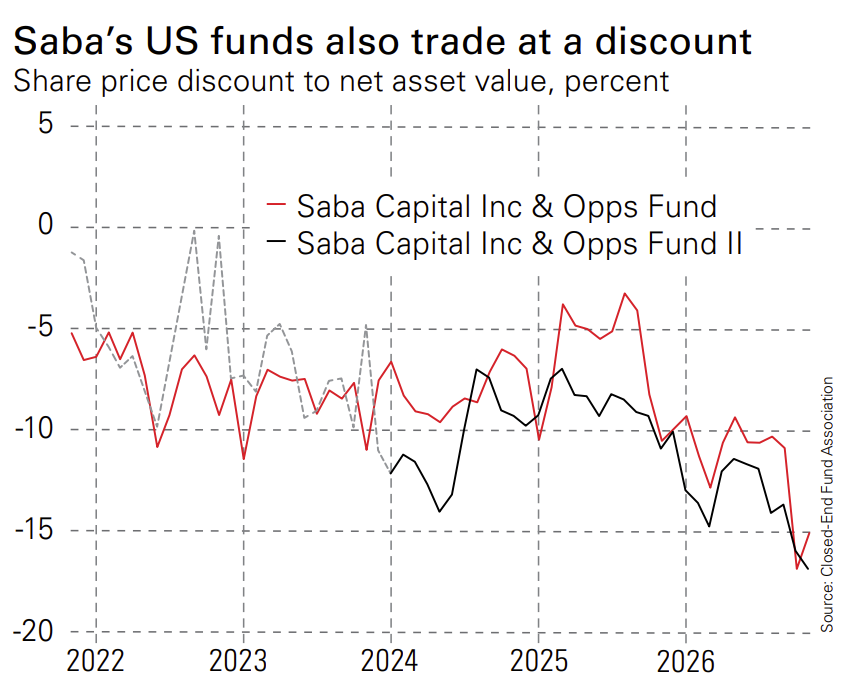
What might investors expect? The chart shows the five-year discount to NAV for two US closed-ended funds: the Saba Capital Income & Opportunities Fund (Saba-run since June 2021) and the Saba Capital Income & Opportunities Fund II (Saba-run since December 2023). It takes a whopper of a brass neck to do what Saba is doing here – and to make its claims about creating value, as repeated by Weinstein at the Sohn Conference last week – given this record. Saba now wants to merge these funds on terms that seem favourable to it as manager.
There are some who believe Saba to be the saviour of the trust sector, on the basis that it bought when nobody else did, thereby supporting share prices. Yet its actions are harmful in the extreme. Time will no doubt illuminate the flawed actions of this transactional tourist. In the meantime, we at Rossie House will do what we can to support – and where possible, protect – these long-term vehicles.
Scott Baikie is a partner at Rossie House, an Edinburgh-based discretionary investment manager
This article was first published in MoneyWeek's magazine. Enjoy exclusive early access to news, opinion and analysis from our team of financial experts with a MoneyWeek subscription.