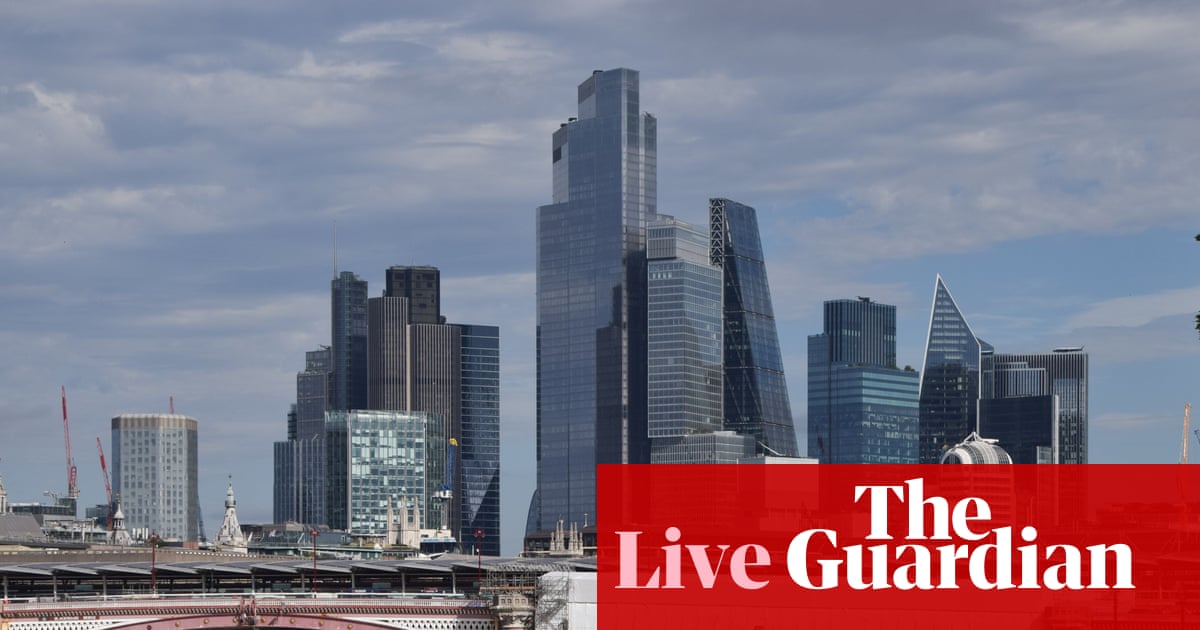
Newsflash: Britain's government has paid the highest interest rate since 1999 on a sale of 10-year bonds this morning.
An £4.25bn auction of a new UK gilt maturing in 2036 has just concluded, with bond investors successfully demanding an average yield of 5.383% when bidding to buy the debt.
That's the highest yield, or interest rate, since September 1999, reports.
The auction, held by the , received bids for more than three times as much debt as was for sale, showing investors were still keen to buy UK debt, but at a price….
This results follows months of turmoil in the government bond markets, driven by inflation fears, which has driven up the yield on debt traded between bond investors.
Today's auction highlights that those moves have real implications for the government, as higher bond yields push up the cost of servicing the national debt.
Earlier this month, the UK government was forced to pay the highest interest rate for a 30-year bond since 1998.
These costs have obvious implications for the government's spending plans, ahead of Andy Burnham's speech to Labour's party conference at 2pm today….
Shares in UK water companies are dipping on the stock market, after UK prime minister Andy Burnham pledged to repeal a ban on the public ownership of water companies.
Speaking at the Labour Party conference in Liverpool today, cites the water industry as a symbol of what has gone wrong with Britain.
says the water companies have "siphoned out easy money while the public picked up the bill for the sewage in our seas."
He goes on to promise tougher regulation, saying:
It stinks. I will not allow it.
Today I can confirm Angela Eagle will present a strengthened water bill to parliament. The centrepiece of that bill will be this – the repeal of Margaret Thatcher's ideological [ban on the public ownership of water] …
It will strengthen public control. Mayors will have new powers to hold water, companies to account …
It will close loopholes used to pay excessive bonuses. Where private companies serve the public interests, we will support them. But the consequences will be clear for those who do not, including taking back control or public ownership.
Shares in are down 0.8%, with down 0.6%.
[ own South West Water, who have just been fined for sewage failings].
Our Politics Liveblog has full details of speech:
Elsewhere in the financial markets, the oil price is dropping.
Brent crude has dropped by 2.1% to around $103 a barrel, helped by signs that exports from the Middle East may be picking up.
Crude exports from major Middle Eastern producers climbed to 12.8 million barrels a day in September, the highest since February, preliminary figures from data provider Kpler showed on Monday.
Reports that Saudi Arabia has restored about half the capacity of its East-West pipeline, which was hit by drone attacks this month, also pushed oil down.
This morning's UK 10-year bond auction saw relatively weak demand, Bloomberg reports:
Tuesday's offering received bids 3.34 times the amount on offer, lower than last month's sale which was oversubscribed more than 3.6 times.
The auction tail — the difference between the yield at the weighted average accepted price and the lowest accepted price — also pointed to weaker appetite. The tail on Tuesday was 0.5 basis point, compared with 0.1 basis point in August.
Newsflash: South West Water has been fined more than £7.8m for committing environmental offences across Devon and Cornwall over a six-year period.
It is the largest ever fine imposed for environmental offences in the region, according to the .
And it follows an unpleasant wave of sewage spills, totalling many hundred in total, which took place over six years at popular bathing spots in the region.
The offences took place between January 2015 and July 2021 in locations across Cornwall and Devon: Bodmin, Harlyn, Playing Place, Polperro and Plymouth, and will be stomach-churning for anyone who holidayed in the regions at that time.
For example:
-
On 24 August 2019, "untreated sewage gushed through the harbour wall on a bank holiday weekend" at Polperro Harbour.
-
On 231 occasions between January 2016 and July 2021, untreated sewage was discharged onto Harlyn beach, a location popular with locals and tourists.
-
At SWW's sewage works near Bodmin, there were 336 illegal spills in the seven years to March 2020.
, area environment manager at the , says:
Hundreds of pollution incidents occurred at some of the most scenic locations in Cornwall and Devon, including bathing waters, a designated Special Area of Conservation and a priority habitat.
South West Water have promised the public that one pollution is too many, and our officers are out every day holding them to account.
We hope this record fine will influence a new approach for South West Water, where protecting the environment takes priority in spending decisions.
Summit Therapeutics, the Miami-based cancer drug developer that AstraZeneca is investing $2bn in (see earlier post), was co-founded in 2003 by the UK geneticist and Oxford University emeritus professor, Kay Davies. is a respected figure in human genetics, known for her research into the molecular basis of neuromuscular and neurological disease.
Summit is run by co-CEOs , an American entrepreneur, and , both billionaires who married in December 2024, after their previous success building and selling Californian firm Pharmacyclics for $21bn to AbbVie in 2015. owns a majority stake of more than 70% in Summit.
The pair are passionate about cancer fighting drugs partly because of their own personal experience. survived breast cancer, and son died from brain cancer, according to Forbes.
Born in Iran, fled to Germany with her family after the 1979 Islamic Revolution, and did a degree in dentistry and an MBA. She ended up working for a US surgical robot firm where she met , a prominent Scientologist and serial entrepreneur, according to Forbes, who described the couple as "biotech stars".
Labour plans to allow regional mayors to borrow against revenues they generate from local tourist taxes in their areas, as part of sweeping new devolution powers expected to be announced before Christmas, the business secretary has said.
said the government would announce the details of a new "rewiring the state" white paper before Christmas, my colleague Richard Partington writes.
As part of it, he said directly-elected mayors would be given powers to borrow against the revenues of tourist taxes to fund priorities in their local areas.
says:
"Fiscal devolution in terms of taxation, like the visitor levy, that's how people will use it. They will have a revenue stream they can borrow against."
also said the government will take into account the "significant ask" placed on businesses from tax rises at next month's budget, as he said his department was pushing for action to cut energy costs.
Speaking in conversation with the boss of the British Chambers of Commerce at Labour's annual conference in Liverpool, the business secretary said he had made "offensive and defensive asks" of the chancellor, , before next month's budget.
He added:
"There's been a significant ask of business, the prime minister used these words, in previous budgets. I think that has to be taken into consideration."
There is some relief for UK households this morning, though – gas price have fallen.
Gas prices have fallen – with the month-ahead UK gas price down 4.3% to 175p a therm.
That will help, as people also face pressures from higher mortgage costs and diesel prices.
Consumers were determined to carry on spending last month, despite high fuel prices, the latest credit survey from the Bank of England shows.
Consumer credit flows were strong in August, surprising analysts after the month-to-month change in net consumer credit – the "net flow" from lenders to consumers – hit the highest on record (measured in pounds), my colleague Phillip Inman writes.
, chief UK economist at , said it was significant that the net flow was the highest since the Bank started collecting the data in 1993.
The figure for August was £2.5bn in August, up from £2.1bn in July, and above the six-month average of £1.9bn.
He said the next highest was a £2.3bn net flow in consumer credit posted in January 2005.
said the strength of consumer credit was "far from just a flash in the pan caused by the energy shock" when it has been trending upwards since late 2024.
After the turbulent Tory years, it seems that consumers are more willing to bet that under the Labour administration they can afford to borrow without too many shocks to derail their repayment plans.
Consumers are also using their savings to maintain their spending habits.
In a slice of good news for ahead of next month's budget, said the impact of a more resilient consumer would be felt in official figures estimating economic growth. He said growth was likely to be 0.4% in the third quarter while his 0.1% forecast for the fourth quarter could be revised upwards.
The chancellor will also have appreciated figures that showed lending to businesses remained strong.
However, , chief UK economist at the consultancy , was more circumspect, saying the consumer credit boom could soon run out of steam.
"It seems unlikely that households will continue to fund increases in their real spending by borrowing more and reducing their saving rates, as they did in August, for much longer.
He added:
"Households won't be able to cushion the blow to their real incomes from higher energy prices indefinitely. At some point, they will have to rein in their spending. We suspect that could happen in the fourth quarter."
Back in the pharmaceuticals world, Denmark's Novo Nordisk has secured the rights to a new weight-loss drug developed in China.
will pay up to $2.6bn to for the rights to its experimental weight-loss pill, called HRS-1596. The deal expands Novo's pipeline through a second GLP-1 treatment deal with a Chinese partner.
HRS-1596 is approved in China to initiate Phase I clinical trials for weight management and type 2 diabetes.
The tie-up could help to compete in the weight loss drugs market. It had emjoyed an early lead in this market with its Wegovy and Ozempic products, but rivals such as Eli Lilly have been grabbing market share with their own weight loss pills.
Newsflash: the price of diesel in the UK has moved closer to £2 a litre for the first time.
The average price of a litre of diesel has hit a new all-time high this morning, at 199.53p, a day after hitting a new record high of 199.18p.
Since the Iran war began, the average price of diesel has risen by 40%, as the jump in crude oil prices drove up the cost of refined products too.
Attacks on Russia's oil refinery by Ukraine have also pushed up diesel prices, prompting warnings that motorists and businesses are facing painfully higher prices at the pumps.
Motor fuel prices across Europe have hit record levels in recent weeks, prompting calls for political leaders to take action to safeguard consumers against rising cost pressures.
Business secretary Jonathan Reynolds has suggested he's fighting for more support for businesses with their energy costs, ahead of next month's budget.
Asked about soaring costs in a fringe meeting at Labour conference this morning, said:
"I go to bed thinking about industrial energy prices, and I wake up thinking about it."
He highlighted the existing British Industrial Competitiveness Scheme which will cut costs for some firms - but hinted he would like to do more, saying:
"It's one of the strongest causes I fight in government and I have done from day one and I continue to do that - and I think my arguments are strong."
Jo Bertram, the chief executive of mobile giant O2's business operation, is leaving the company after eight years, my colleagues Anna Isaac and Mark Sweney report.
, a former senior Uber executive who also sits on the board of Sainsbury's, will be replaced on an interim basis by Matt Riley, the chair of .
joined the telecoms company in 2018 after abruptly leaving Uber after the ride hailing service battled regulators which at the time had banned it from operating in London.
Her departure comes after seeing through the initial phase of the combination of and telecoms group , which merged last year to create a £3bn business telecoms group with hundreds of thousands of customers including Sainsbury's, the NHS and British Sugar.
In April the operation, initially branded as O2 Daisy with holding a 70% stake, was rebranded as O2 Business.
was originally hired by Telefonica in March 2018 as chief digital and strategy officer of O2.
Two years later Virgin Media, then 100% owned by US cable giant Liberty Global, and Telefonica announced a £31bn mega merger of their UK operations.
Earlier this month the business, which is jointly owned by Liberty Global and Telefonica, reportedly kicked off a £600m cost-cutting programme including job cuts as it looks to deal with a £22bn debt pile.
A spokesman for confirmed departure, saying:
"Jo has held a number of executive positions during her time within the company and played a pivotal role in the completion of the merger between O2 Business and Daisy Group, successfully leading integration activity during the first year of the new business.
We'd like to thank Jo for her leadership and significant contribution during her time at the company."
UK mortgage rates are unlikely to drop back unless energy prices fall, warns , managing partner at :
"Buying activity weakened through the summer as rising energy prices pushed up borrowing costs. Lending to homebuyers fell 15% in August compared to the same month a year earlier. At the time, leading fixed rates were edging closer to 4.5% – they've since risen to 4.8%.
"The large lenders are doing business with very thin margins in an attempt to retain market share, which leaves them vulnerable to swap rate volatility. Without a sustained fall in energy prices, leading fixed rates are likely to remain around 4.5% through the autumn selling season, which will keep a lid on activity.
"The government's announcement of a first-time buyer support scheme will provide a boost to sentiment, particularly in more affordable parts of the country, but mortgage rates remain the bigger constraint. A meaningful recovery in transaction volumes is likely to require a sustained improvement in borrowing costs."
Newsflash: Britain's government has paid the highest interest rate since 1999 on a sale of 10-year bonds this morning.
An £4.25bn auction of a new UK gilt maturing in 2036 has just concluded, with bond investors successfully demanding an average yield of 5.383% when bidding to buy the debt.
That's the highest yield, or interest rate, since September 1999, reports.
The auction, held by the , received bids for more than three times as much debt as was for sale, showing investors were still keen to buy UK debt, but at a price….
This results follows months of turmoil in the government bond markets, driven by inflation fears, which has driven up the yield on debt traded between bond investors.
Today's auction highlights that those moves have real implications for the government, as higher bond yields push up the cost of servicing the national debt.
Earlier this month, the UK government was forced to pay the highest interest rate for a 30-year bond since 1998.
These costs have obvious implications for the government's spending plans, ahead of Andy Burnham's speech to Labour's party conference at 2pm today….
The fall in mortgage approvals last month shows that higher borrowing costs are taking a toll on activity in the housing sector, reports , chief UK economist at .
told clients:
Even though the Bank of England has not (yet) raised interest rates, the further fall in mortgage approvals from 56,000 in July to 54,900 in August (the lowest since December 2023) shows that the sharp rise in mortgage rates is restraining activity.
At face, value, that's consistent with house price inflation slowing from 1.7% in August to around 0% in six months' time.
Higher borrowing costs and continued macroeconomic uncertainty are "slamming the brakes on the mortgage market", warns senior director at banking and credit advisory consultancy .
Responding to this morning's data showing a drop in mortgage approvals, says:
"Despite some of the green shoots of economic recovery we have seen through the year, affordability pressures are clearly still biting as households head towards another challenging winter.
"The sharp rise in consumer credit borrowing, particularly on credit cards, suggests more households are leaning on credit to absorb everyday cost pressures.
"For lenders, the priority must be to identify signs of financial strain as early as possible and ensure borrowers have access to appropriate support and flexibility before temporary affordability pressures become more serious."