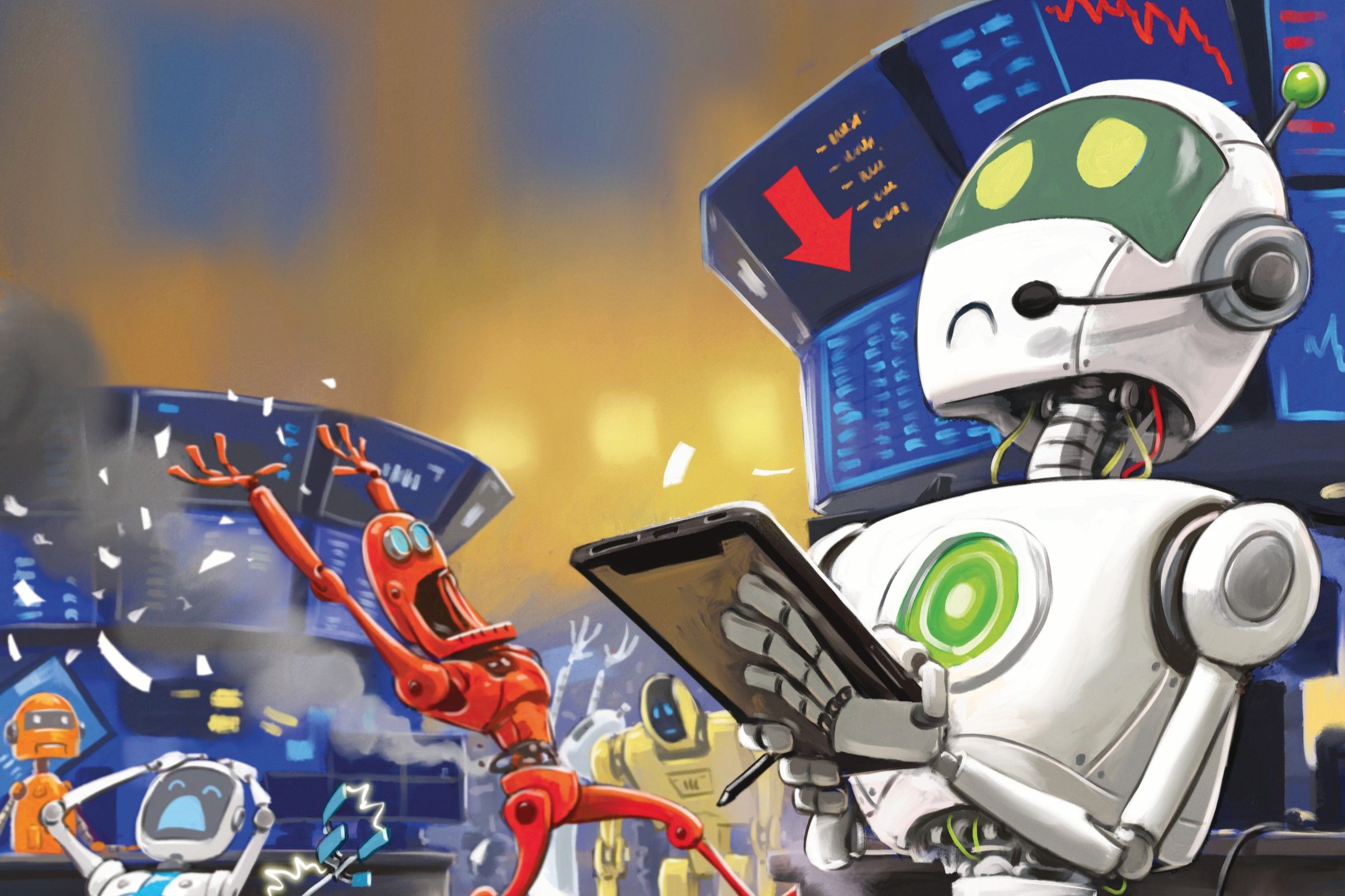
The trouble with trying to invest in AI stocks (or avoid them) is that it is difficult to tell which firms are AI plays and which are not. At different points, big tech, software, semiconductors, emerging markets and energy firms have variously been declared AI winners and AI losers. Investors are left feeling like they are chasing a phantom.
The first phase of the frenzy in AI stocks
In 2023 and 2024, during the first phase of the AI stock frenzy unleashed by ChatGPT, markets operated with all the financial savvy of Del Boy, indiscriminately pricing most stocks – and especially anything tech-related – as if they would soon make us all millionaires. The first signs of doubt emerged over the likes of Mark Zuckerberg's Meta, big-tech “hyperscalers” whose colossal balance sheets underpin the AI infrastructure boom.
Investors have gone back and forth on whether the hyperscalers are overspending on AI, alternating between sell-offs when big tech is judged to be incinerating cash (what's a couple of hundred billion dollars between friends?) and rallies when growth in revenues appears.
Start your trial of MoneyWeek today
Get unparalleled financial insight, analysis and expert opinion you can profit from.
Start your trial
Sign up for MoneyWeek’s free twice-daily newsletter.
Join more than 165,000 subscribers and keep yourself informed with latest financial news, insights and expert analysis to help you understand what really matters when it comes to your finances.
Join more than 165,000 subscribers and keep yourself informed with latest financial news, insights and expert analysis to help you understand what really matters when it comes to your finances.
It was only in February 2026 that investors began seriously to contemplate the idea that AI might create losers as well as winners. With the chatbots appearing to be especially good at coding, the short sellers descended on software: in the first half of this year, Adobe's and Salesforce's shares both sold off 38%. The big software short coincided with a red-hot rally in the computer-chip companies that were supposed to be putting programmers out of a job. South Korean shares tripled in the 12 months to 19 June.
The “sell software, buy chips” trade now appears to have run its course. Korean shares crashed; the S&P software index recovered nearly all its losses for the year.
Investors remain nervy about AI stocks
Last week technology shares sold off sharply, with the Nasdaq entering a correction (a 10% fall from the peak). Trading stabilised early this week, although investors remained nervy, not least about a spy drama at Nvidia. The sharp reaction was triggered by the US midterm “blue wave”. While policymaking in Washington is likely to be gridlocked as a Democrat congress quarrels with a Republican president, investors' concerns focused on state elections. Democrats who took a stand against data centres won the governorships of states that are key locations for America's data centres. That is bad news for chip firms, which could see demand for their wares fall short of projections, says Telis Demos in .
But talk of more AI red tape has lifted shares in giants such as Amazon and Microsoft, which already run large data centres and are now likely to face less competition from new entrants. Recently, investors' “major concern” has been that big tech would overbuild data centres beyond the point at which these assets could secure a good return on investments. Ironically, traders appear to have concluded that left-wing regulators might save Silicon Valley's AI-loving bosses from themselves.
Power companies may be the biggest losers of a slowdown in the building of US data centres. A shortage of electricity has been the main bottleneck slowing new construction, with grid connections often taking five years or more to secure. Keen to obtain power more quickly, operators turned to “off-grid” technologies, which can be installed in about 18 months. Now that bottleneck is looking a little less congested. Abundant energy and light-touch regulation had seen the likes of Oracle, OpenAI, CoreWeave and Amazon pile into Texas with new projects, says Avi Salzman in . But now Gina Hinojosa, the state's new Democrat governor, appears likely to extend a moratorium on data centres until new laws account for AI's impact on water and power bills. Moratoriums in Texas, Georgia and Ohio could affect 45% of all planned data-centre capacity, according to Goldman Sachs.
Shares in Constellation Energy, America's biggest electricity generator, are down a quarter this year. Power-plant operators such as Constellation had already fallen from favour with investors because of growing political pushback to hooking new data centres up to overstretched grids, says Jinjoo Lee in . Investors who had grown excited about power-equipment makers whose kit can be deployed “off-grid” will also be disappointed. Shares in turbine maker GE Vernova doubled in the first half of the year, with Caterpillar, another equipment maker, gaining 77%. These shares have suffered sell-offs following the election.
Utilities were once seen as safe havens, says Emily Forgash on . AI has changed the picture. Utilities are the second-worst performing of the S&P 500's 11 sub-sectors this year, not least because rising interest rates place stress on a sector that is by its nature heavily indebted.
This article was first published in MoneyWeek's magazine. Enjoy exclusive early access to news, opinion and analysis from our team of financial experts with a MoneyWeek subscription.