is the sixth-largest global pharmaceutical firm by sales. With shares in AI companies and their suppliers displaying extreme volatility recently, it's a good idea to add such companies to your portfolio – growing and profitable companies in sectors unrelated to aI where the share prices are likely to be less volatile.
AbbVie has a market capitalisation of $506 billion and has 12 blockbuster products on the market (products with annual sales of more than $1 billion). It has an interesting history dating from 2013, when the health conglomerate Abbott Laboratories split into two specialist companies. These were AbbVie, specialising in patented biopharmaceuticals, and Abbott Laboratories, which retained medical devices, diagnostics and generic drugs.
One of AbbVie's drugs – Humira for arthritis and psoriatic arthritis – was the world's best-selling drug for the ten years up to 2022 and generated cash for research and to develop new drugs. Humira's patent had expired by 2023, so sales dipped then as generic competition started, although even in 2025 sales were still $3.1 billion. But being aware of the patent expiration, AbbVie developed two improved drugs to replace Humira – Rinvoq for rheumatoid arthritis and dermatitis and Skyrizi for psoriatic arthritis and psoriasis, which are now its two top-selling drugs. That attests to the strength of the company's research and development.
Start your trial of MoneyWeek today
Get unparalleled financial insight, analysis and expert opinion you can profit from.
Start your trial
Sign up for MoneyWeek’s free twice-daily newsletter.
Join more than 165,000 subscribers and keep yourself informed with latest financial news, insights and expert analysis to help you understand what really matters when it comes to your finances.
Join more than 165,000 subscribers and keep yourself informed with latest financial news, insights and expert analysis to help you understand what really matters when it comes to your finances.
AbbVie has a well-stocked pipeline
AbbVie's pipeline of potential new drugs is focused on immunology, oncology and neuroscience, with smaller efforts in aesthetics and eyecare. And there are new targeted investments in pipeline drugs for obesity and hypothyroidism. There are 16 drugs in Phase-III clinical trials (the final phase) or registration, of which three are for immunology, nine for oncology, two for neuroscience, one for eyecare and one for hypothyroidism.
The FDA, the US regulator, recently awarded breakthrough drug designations (BDD) for AbbVie's Temab-A, a next-generation drug for treating colorectal and non-small-cell lung cancers – both among the top four most prevalent cancers. A BDD means that the FDA speeds up its approval process because of the big potential benefits the drug holds for patients. The FDA also recently approved AbbVie's Juvmo, the only treatment of its type for Parkinson's disease.
AbbVie invested 14.9% of sales in research and development for the third quarter of 2026 and supplements its own efforts with bolt-on acquisitions.
In 2026 it acquired Apogee Therapeutics, which specialises in dermatological, respiratory and other inflammatory and immunological diseases, for $10.9 billion. In 2023 it acquired Cerevel Therapeutics, a specialist in neurological diseases, for $8.7 billion, and ImmunoGen, a specialist in oncology, for $10.1 billion.
The 2025 results show revenues of $61.2 billion, up 8.6% on 2024. The major contributors were immunology 49.7%, neurology 17.6%, oncology 10.9% and aesthetics 8%. Operating profit was $15.1 billion, up 32%.
AbbVie has three major growth drivers. The first is the sales growth of its top two drugs – Skyrizi and Rinvoq – which, in 2024, it predicted would achieve 2027 sales of more than $27 billion compared with $16 billion in 2024. But sales in the first nine months of 2026 were $18.7 billion with $8.5 billion in the third quarter, so the $27 billion total will be reached in 2026. The second driver is the bolt-on acquisitions, which bring not only drugs already on the market, but pipelines of potential new drugs in clinical trials. The third is AbbVie's own research and development and its well-stocked pipeline. These three drivers have driven revenue growth from $54.3 billion in 2023 to $66 billion for the last 12 months.
AbbVie's impressive record of paying dividends
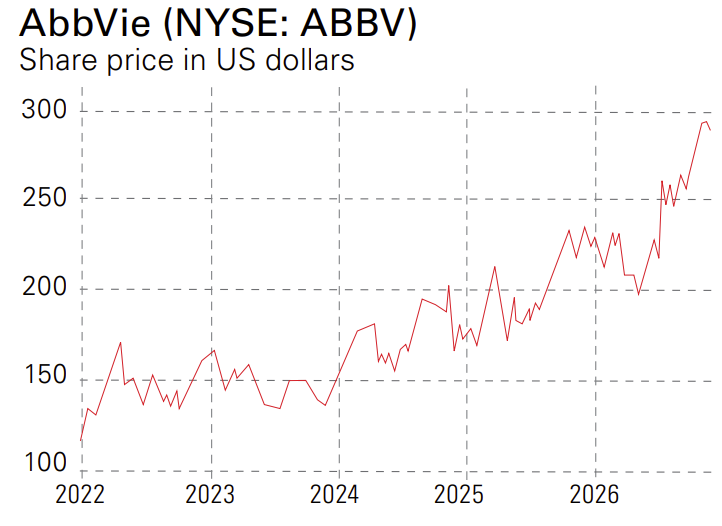
AbbVie has a fine record of paying dividends and they have been raised every year since it became a public company in 2013. The dividend was $1.60 per share in 2013 and rose year by year to $6.56 for 2025. The dividend for 2026 is $6.92 per share, a 5.5% increase on 2025.
The shares have risen from a low of $134 in mid-2023 when its arthritis drug Humira recently came off patent to $286. Analysts have a median one-year target price of $321.
The main uncertainty in 2023 was whether its top-selling drugs Skyrizi and Rinvoq would be able to grow fast enough to replace Humira sales lost to generics. This was achieved. Skyrizi and Rinvoq are expected to make sales of about $27 billion in 2026 compared with $21 billion for Humira in its peak year of 2022.
AbbVie’s net debt at the end of the third quarter of 2026 was $70.1 billion, mainly due to recent acquisitions – it’s manageable as free cash flow was $7.3 billion and interest paid was only $0.8 billion. For the nine months to the end of September, revenue was up 11.1% and operating profit 58.5%.
The average analysts’ estimates for AbbVie’s forward earnings per share are $14.01 for 2026, $16.26 for 2027 and $18.08 for 2028. At the recent share price of $286, these estimates give forward price earnings rations (P/Es) of 20.4 for 2026 falling to 17.6 for 2027 and 15.8 for 2028. Twenty-four analysts out of 32 rate AbbVie a “buy” or “overweight”, with seven on “hold”, one “underweight”. The forward dividend yield is 2.42%.
AbbVie is a major pharmaceutical company with 12 blockbuster products already on the market, a strong pipeline of new products from an effective research and development operation, including the multibillion-dollar potential of Temab-A. That’s not to mention the bolt-on acquisitions and a dividend increased every year since 2013.
This article was first published in MoneyWeek's magazine. Enjoy exclusive early access to news, opinion and analysis from our team of financial experts with a MoneyWeek subscription.